
Off the coast of southern New South Wales, the albatross appeared at first singly, then in twos and threes. On the third day of sailing from Sydney to Eden, eight black-browed albatross swept around us on their calm, broad wings.
I did not grow tired of looking at them: distant against the waves with the naked eye or seeming, when seen through binoculars, to be gliding at great speed yet so near.
One afternoon after the birds have been absent for a while I look across to the eastern horizon and see that one has returned. This bird is different to the black-browed albatross. Languidly soaring across the waves, it banks and I see its enormous wingspan, white back and speckled pattern leading into dark wings.
It is not until I look at the bird book later that I realise it is a wandering albatross. I am stunned: the wandering albatross is something out of seafaring mythology, yet it has come soaring into my presence, gliding into my modern world, enlivening another day on the ocean.
 I feel an uplifting of the heart; a passion kindled. To see these birds up close, determined in their line of flight, their sleek perfectly white bodies bright against the rich grey on their wings, is to feel humbled and hopeful.
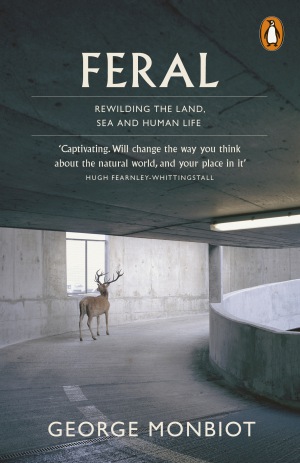
Hope has been on my mind since reading Feral: Rewilding the land, sea and human life (2014), by British journalist George Monbiot. He argues that hope is vital if humans are to feel any sense of belonging in an ecological world.
Monbiot’s Feral is at its heart a piece of nature writing; a project driven by the need to escape the constraints of modern human existence. He writes of paddling out to sea, seeking a place in which he feels ‘a kind of peace’:
The salt was encrusted on the back of my hands, my fingers were scored and shrivelled. The wind ravelled through my mind, the water rocked me. Nothing existed except the sea, the birds, the breeze. My mind blew empty. (p16)
I began reading Feral when I joined the HMB Endeavour as crew in late 2014. Two months later, after two stints on the ship and with an interlude hiking in the bush in between, I felt that Feral had played some role in shaping my relationship with both the sea and the land during that time.
Monbiot writes beautifully of the natural world but he also has important arguments to make. He argues that humans have lost their connection to the natural world and that we are poorer for it. The loss of this connection is damaging to wild places but to humans as well – so for our own sake as much as for the sake of ecosystems, we must ensure that wild places still exist and that humans can access them. Humans themselves need to be ‘rewilded’.
Rewilding is a relatively new term, yet is already defined in a number of different ways – perhaps most widely as meaning the rehabilitation of entire ecosystems. It has entered the conservation lexicon, including in the form of conservation groups Rewilding North America, Rewilding Australia and Rewilding Europe. The latter defines rewilding loosely as an approach to conservation where ‘the concept of wild nature and natural processes is accepted as one of the main management principles’.
So how does this relate to humans? Monbiot sees rewilding as an opportunity for humans to be re-involved in nature – as ‘an enhanced opportunity for people to engage with and delight in the natural world’ (p11). This might sound like public relations speak for an ecotourism outfit, but the lack of engagement in the natural world is at the crux of Monbiot’s creeping sense of dissatisfaction with the civilised life he leads.
In the book’s first chapter, he writes,
If you are content with the scope of your life, if it is already as colourful and surprising as you might wish, if feeding the ducks is as close as you ever want to come to nature, this book is probably not for you. But if, like me, you sometimes feel that you are scratching at the walls of this life, hoping to find a way into a wider space beyond, then you may discover something here that resonates. (p11)
The second and lengthier part of Feral‘s argument is about the rewilding of places and landscapes. Wild places, for Monbiot, are places where the trophic webs function properly and ecosystems are species-rich. They are places where humans do not interfere, except to reintroduce missing key species that enable an ecosystem to function and ‘ecological processes to resume’ (p8). This reintroduction, if done right, is the catalyst for rewilding the land.
Monbiot argues for the reintroduction of large herbivores and key predators to enable the full functioning of trophic webs in natural ecosystems. The most famous example of a reintroduction of this kind is that of wolves into Yellowstone National Park – a move that quickly proved effective at reducing populations and changing behaviour patterns of the elk that were damaging the Park’s vegetation and river banks, leading to flow-on impacts for other parts of the ecosystem.
The Yellowstone National Park reintroduction appears to have worked, with beavers, birds and fish among those who benefited from the changed behaviour of the elk. Monbiot argues that certain reintroductions are required in the UK to re-establish functioning ecosystems.
Monbiot wants people to resist their impulse to control, corral and tidy wild landscapes, but he is equally aware that many ecosystems are far too damaged for us to simply step back and allow rewilding to happen on its own accord. Reintroductions of keystone species might go part of the way to restoring natural processes, but it seems simplistic to assume that this will be enough in most cases.
Here in Australia, the concept of rewilding – of allowing wild processes to proceed without human interference – is severely complicated by the fact that much of our flora and fauna has evolved in conjunction with the land management practices of Aboriginal people, particularly in relation to fire regimes. Reintroducing keystone species and walking away is not going to solve all the problems that Australian ecosystems face.
Feral is set almost entirely in the UK, with examples drawn from other parts of the world. For an Australian reader it is fascinating because the UK and Ireland deal with an entirely different set of historically created ecological problems than what we do here in Australia. Australians tend to view our fauna and flora in a black-and-white fashion as either native or introduced – present prior to European settlement or introduced by Europeans – but arguments about what constitutes native or introduced in the UK are much more fraught.
Monbiot argues that European conservationists in the traditional mould are highly conservative (linguistically this makes sense) and aim only to ‘preserve’ nature as it was in their own childhoods or in recent historical memory. Thus the desolate moors of Wales are considered in need of conservation – something Monbiot considers absurd given the paucity of species in these ‘moonscapes’. Sheep-damaged moors have been the norm in the UK for such a long time that few people can envision a more species-rich, functioning ecosystem such as might have existed before sheep came to dominate the landscape.
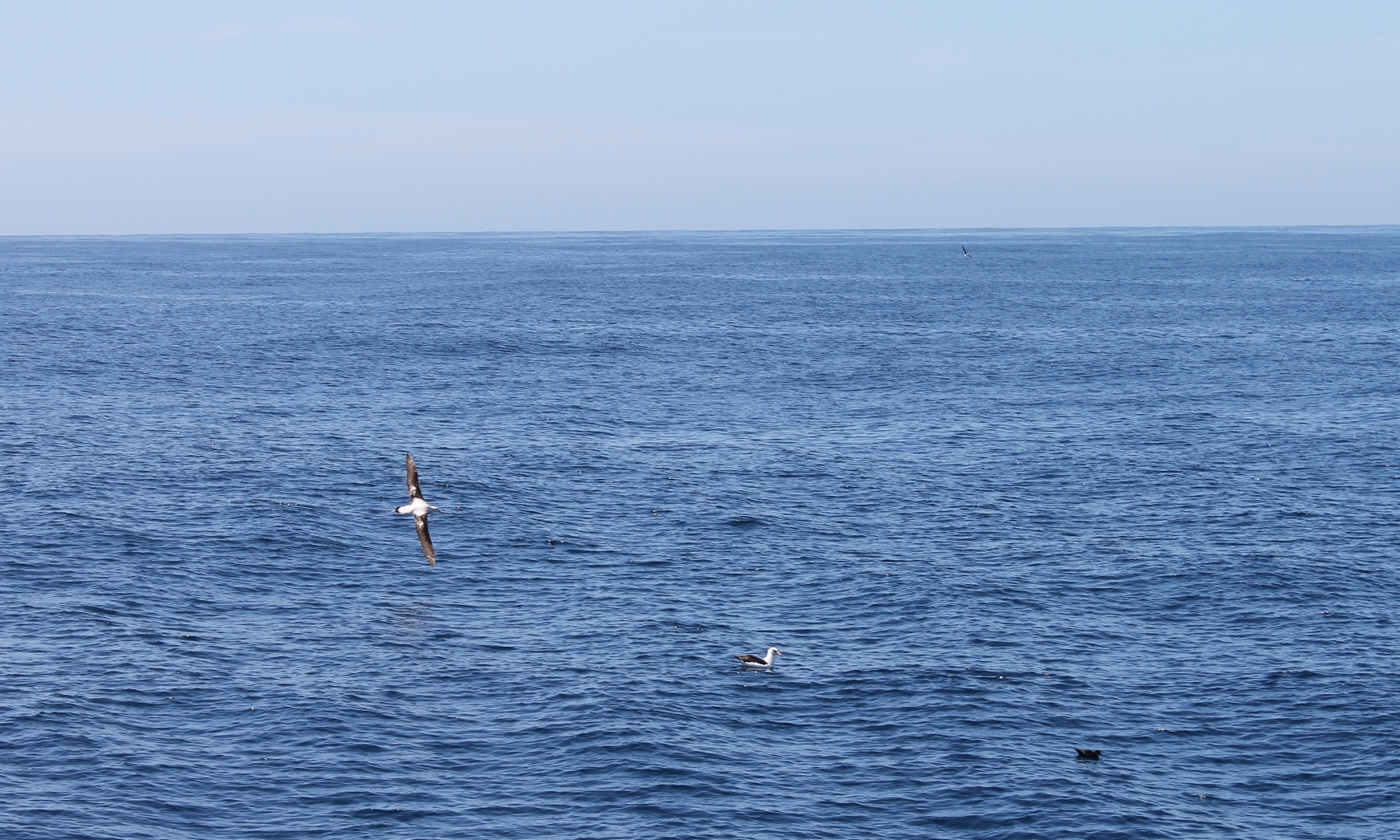
Albatross and shearwater off the coast of NSW.
I understand Monbiot’s yearning for nature. I feel it when dolphins come to play in the port of Fremantle in WA: they are wild things brought so close, yet in the midst of a city I am painfully aware of how distant they really are.
I feel it when I walk through the bush and do not understand its structure or the animals that live in it and cannot always identify invasive flora.
I feel it on the open hillsides of East Gippsland in Victoria when I try and reconcile my love of a landscape that is part of my childhood with the destruction of functioning ecosystems that accompanied the clearing of it for agriculture.
At sea, with albatross soaring around me, there is a sense of hope, but this too is transient and perhaps misplaced. Visually the ocean off the east coast of Australia seems untouched, but that is partly because the currents have taken our litter away to an ‘island’ of rubbish in the middle of the Pacific. Monbiot’s chapters about the sea are amongst the most powerful in the book, perhaps because it is harder to see or understand the impacts of humans on the ecosystems of the sea.
As well as hope, Monbiot’s book provides a stark reality check about the challenges our ecosystems face. It is a powerful reminder of the complexity of the natural world and of how important it is to the health – physical, psychological and emotional – of humans, even if most of us have become so far removed from nature that we barely notice its absence.
Monbiot puts into words a yearning for nature and the desire to understand it that is powerful and vital for us all.
Feature image: credit Shawn Kinkade

 equineocean