Four polaroids of the sea

Four images of the ocean and its edges, in various guises and moods. Peaceful, the tide out, so that light and figures reflect off smooth wet sand. Hidden on impossible film, so it is less the ocean you see and more the curve of the hillside beyond; you can only see the sea if you know where it is. Down by the breakwater, the waves will always break against the rocks, brought up short by them unexpectedly. And out to sea, a rainbow spears from the cloud and into the ocean, mirroring the multiplicities of colour that break and refract through the spray of the waves as they roll, curling, curving, crashing, a flurry of whitewater and sunlight, in towards the shore.

Capture the light

.
We were all rugged up against the cold
Scarves and coats and woollen socks
The sun came out, bright and glaring
Not warm, just sharp.
Casting light-shadows across our faces
Across the close dark weave of his coat.
.

In the south a storm brewed
But we were safe, here
In our slab of sharp sunlight
Surrounded by the cyclone fence
The graffitied wall, the empty showroom
The locked gates, the cracked carpark,
The weeds shooting through the bitumen.

We came for no thing, no solid
Thing to hold in our hands
We came for the light, the sunlight
Or, when the storm came, the cloud light
That fell in streaks between the rain.
We brought what we needed with us
And took only the light home
It is not a thing that you can hold.

But we will try, anyway.
It was yet another day that we could not hold
By mid-afternoon it felt all but over
It spilled away from us easily, too easily
We went to try and slow it down.
Only the capture of light, the taking-home of light,
Could slow it down, pause it for a moment.

We went home together in the rain.
The sunlight was gone
But we carried the light with us
Between us, around us, beneath the black umbrella
It’s not a thing you can hold
But we carried it, all the same.

Photo: Melbourne, winter 2011 (film: Kodak T-Max 100)
Text: Stream-of-consciousness in response to the photo

Eclipse of the moon

This morning, just before sunrise, there was a total eclipse of the moon.

We were woken at 4.50am. I went into the bathroom and the moon was shining bright in a refracted hexagon through the frosted glass. I opened the louvres, and saw a disc of darkness moving across its face.

We went outside and stood on the grass. The big gum tree diagonally behind our back fence loomed against the sky. All around the sky hazed upwards from light into darkness. The circle of the Earth moved slowly across the moon, leaving a shadow of dark gold against the sky.

The section of the moon that was not yet shadowed grew brighter, and brighter still the smaller it became. First it was a crescent, then the crescent grew so small and bright that its edges blurred, until it became an oval. The cold reached straight through my coat to my skin. We stood there in silence on the wet grass, until finally, the unshadowed part of the moon was a sliver of light and colour. Then it too was gone, and the moon was round and whole again, dark and darkly red against the sky.

An early tram rattled past the junction, and we wondered if the tram driver could see the moon grown red with the ash of Chile’s volcano, passing through the sky above Melbourne. A plane flashed its lights low on the horizon. We shivered, waiting. At this point it was as though the moon had a stain encroaching into it from above – the shadow of the Earth, still moving across the moon’s face, the Earth still not quite dead centre between sun and moon. Earlier, the shadow was a clear, circular disc, sliding its way gently across the moon’s glow; now it was the progress of darkness spreading inwardly through the red circle of the moon.

The moon was much lower now; forty minutes had passed since we woke up, and it was moving into the rim of the sky that glowed with the lights of the city. So as the shadow spread deeper and deeper into the moon it became harder and harder to see it. Directly above the sky was much darker. A shooting star sliced across the space between the rooftop to my right and the trees to my left, ever so briefly dividing the sky. The moon was not quite red anymore; it paled. We watched until it disappeared against the glow of the sky, and then we went inside.

A little while later I came out again, to see if I could see the moon once more as it emerged from ‘totality’. When I opened the door onto the night it was not the cold I noticed but the noise of traffic; it swept into the house from far away. I looked into the space between the trees where the moon had been heading all night, and I thought I saw it, a gentle circle of cream or pink or white against the yellowish glow of the city. I thought I saw it, but if I looked directly at it, it vanished into the sky.

Cicadas

I went for a walk this evening to see the sunset. I was trying to escape the feeling of being boxed up by the squares of the computer screens that were present all day. As I returned from my walk there was a lone woman on the swings, swinging high as adults tend to do. There were no children on the playground, no one else around at all.

I stopped on the other side of the park and stretched. There was still colour in the sky. The evening was warm, and noisy. I hated the squeal of car tires and the sound of engines revving. The background hum of traffic was so loud that I felt it pressing in on me. The trams were ok, clattering down the hill two blocks away. The sounds of the cars made me tense.

I sat down on the grass and changed the tone of my listening, and I heard the cicadas. They comforted me. They sounded as though they were trying to drown out the noise, as though they too could not bear it. I heard them, and they grew louder as I listened.

The girl stopped swinging and walked away. After a while I got up and crossed the park to the swing set. The swing she had left still moved slightly. I swung high into the sky. The colour was fading. After a while a man and two small boys approached. The larger of the boys offered the spare swing to the little one, and the little one took it. After a moment I jumped off my swing, and ran away across the grass.

The other home

Back in Melbourne, and the rain is hissing on the road outside the open window.

In Carlton tonight half of Lygon Street was closed, ready for tomorrow’s festival. A pizza oven was parked where our bus stop should be. So we walked along Elgin Street between the showers of rain, the air still warm and smelling of bitumen. We got a bus and changed to a tram at the junction.

At home when it rains on the bitumen in summer, the air smells of eucalypt and is washed clean of the sea. But it only rained once that I can remember, all summer at home. It rained just after I left the water one evening, so I missed out on swimming in the rain.

Back in Melbourne, the other home. The sea is far away, but not too far. On Monday a different life begins, a new routine. It is as though the time on the other side of the country exists in a bubble, a time capsule. Melbourne seems unchanged. It is as though I have not been gone at all.

Coming back here makes me glad, because it is good to come back to a place that once was strange and that now is littered with a history of my own. We have a past together, this city and I. We have had this past for a long time, but it takes a year and a half here and a few months away to realise it.

Sometime soon it will be time to live in another city or another place, and then I must remember: after a while, when you have lived there long enough to have a routine and to know some of the place intimately, go away for some time and then return, just to see how it feels to come back.

On coming home

To call it ‘home’ in the first place is supposedly definitive. But it is a word that I interchange, and I am not sure that it is as important as it could be.

I have been gone for fourteen months; it was my third extended absence, and also my longest. I am no returning expat or long-lost child who has been gone for years and years; I am just part of the generation that picks up stumps between 18 and 25 and takes off for a while. Most of us come back, periodically, to confront or remember or re-experience the home that we left.

I feel childlike here, yet I also feel old. I have seen this place across so many years.

There is a sense of belonging, but also a feeling that those with whom I belong are nonetheless moving on without me.

I feel at ease, here in familiar surrounds where the summer sun has the same intensity that I remember. It is a town known for taking it easy, and it’s smoothing me over too, calming me down, bringing me back into its rhythms.

Yet there is the itch of temporariness, the knowledge of another imminent departure. I am constantly wondering if this really is home, to the exclusion of all other places.

This time, I also wonder if I have pushed it too far – if I have been gone too long, so that this place can never be what it once was.

Garden

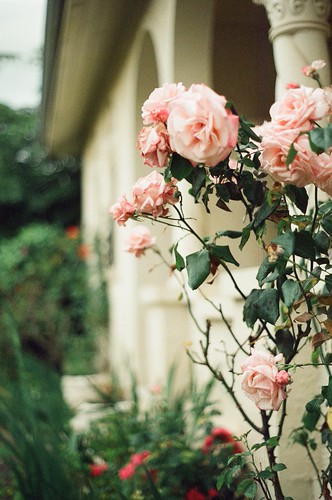
Photo taken by me, on some nameless supermarket film.

I have never been much of a gardener, always keeping too busy with ships or horses. But my Mum is quite the opposite – she has always, as far as I know, had a garden, and throughout my lifetime she has always loved it. Her mother before her was, I think, much the same.

I’m back at home this summer and my parents are away, so I’m left solely in charge of the garden. I don’t have to do much, except for water by hand – almost the entire garden has to be watered every second day, and some plants every day.

The way I feel about this is part of the shift in seeing one’s parents, or at least their endeavours, in a different light – the shift that perhaps every child reaches, gradually or abruptly, at some stage of their teenage years or early adulthood. A few days ago I followed Mum through the garden while she watered. She showed me what needed to be done and how often, pointing out the plants that would droop if I forgot them, telling me which ones to pay special attention in hot weather. And so I had to look at her garden, really look at it. I noticed the garden’s orderliness, its density, its thick greenery; I noticed how each plant has its place and its space. I noticed how Mum watered each with a care specific to it, and how she knew each one. She spoke of her plants as though they were animals, and I remembered how upset she always is if one of them dies needlessly, because of a lack of care.

Yesterday and today I have been on my own in the evenings, retracing Mum’s footsteps with the hose. I have lingered over-long on some plants, not wanting to under-water, not wanting to let any of them die. And I begin to understand why Mum does not seem to see watering as a chore. It is peaceful, wandering the garden in the cool of the evening, listening to the gush of the water, making sure that the water goes straight to the plants and is not wasted. My mind wandered. I thought of the Queensland floods, and I imagined rose bushes underwater or washed utterly away. I thought of sailing, of acres of salt water and its constant motion. I thought of the struggling garden in my grandmother’s house on the other side of the country, where I live.

In spite of these thoughts and their disparity, linked only by water, the garden has made me feel peaceful this evening, and I am glad of it.

Another beginning

The idea of a beginning gives a false sense of security. It feels like an artifice of fiction, the tidy division of events into chapters for a novel. But beginnings are only a human construct, useful for bookending a story, a stage, a journey; as though a life or a journey can be neatly marshalled into a tidy shape.

But athough I distrust the notion of beginnings, I hang onto them all the same. I often think about the beginning of a love affair with the ocean. It seems important, to think about how this began.

Ironically, it feels as though the love of the ocean arose because of a love of the land and of horses. This love led to early mornings when racehorses skirted the waves on the beach, day after day. On these mornings the ocean became unexpectedly important, though perhaps you didn’t notice this until later. From there, the rest is inevitable: the first voyage on a tall ship, the movement of the ocean ceaselessly in your thoughts.

Yet before all of this you had sailed on the ocean unaware, lacking conscious memory, part of a different beginning. And before that there was the ocean itself, stretching back to its own distant ‘beginnings’, far far away in geological time.