Black and white, textures of the land
In the high country in June, it was very cold but the sun shone. Up high on the hillside, gazing out across the valley, the colours sang. But so too do the textures; the textures of hillsides and shadows, of dead trees and living. Sometimes these are textures best caught in black and white, as No Fixed Address has in these images.

Dead trees and living – Canon EOS 3000V, Rollei Retro 100

Sunlight on her coat – Canon EOS 3000V, Lucky SDH 100

Cattle on the hillside – Canon EOS 3000V, Lucky SDH 100
Frosty morning
From a cold and icy morning on the farm in Victoria’s high country in mid June:

The meaning of the frost

Iced Volvo
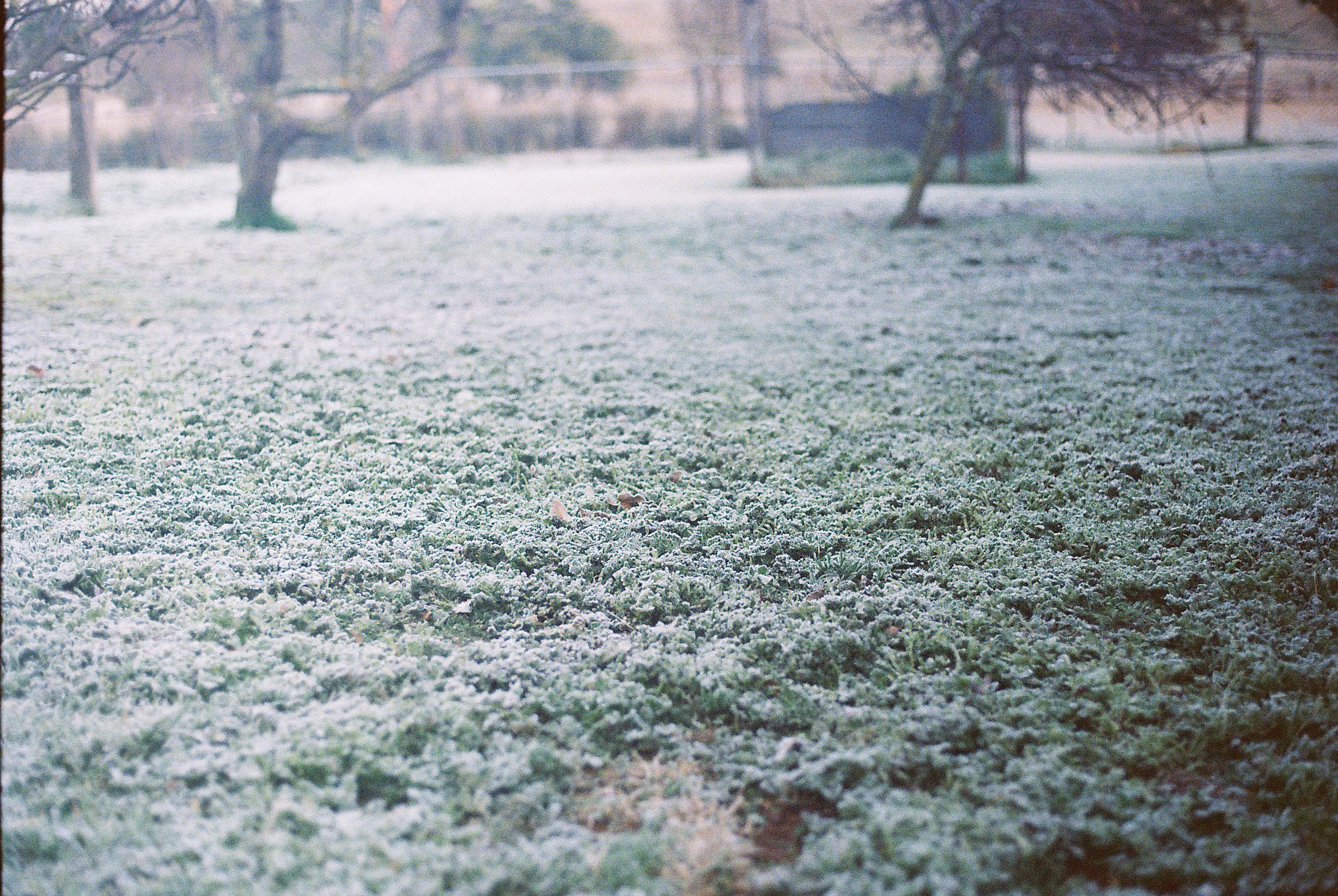
Underfoot and into the distance
It’s over two months since I last posted on this blog. These photos, by way of explanation, are from the place that I went to in June and July, and which sharply interrupted my blogging habit. There is no internet connection at the house. In this place, few things seemed less important than the online world.
Images: Olympus OM-1n, Kodak Gold 400.
Book review: Eleven Seasons by Paul D. Carter
 For outsiders, the attraction of Aussie Rules football is hard to understand. In WA it hovered at the edge of my consciousness in winter, and I chose a team as an easy way of identifying my allegiances to the north or the south of the river.
In Melbourne, football culture assaults me with the presence of loud fans in the city after games. Wide-eyed children on the tram, bedecked in team colours with a parent by their side, bring to mind memories of my mother’s stories, of going to the football as a teenager with a much-loved older cousin who has long since passed away.
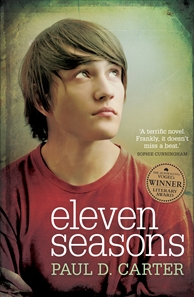
Bruce Dawe’s poem ‘Life Cycle’ gave me something of an insight as a youngster into what it meant to grow up with football in Melbourne. Now, Paul D. Carter’s Eleven Seasons, which won the The Australian/Vogel’s Literary Award for 2012, has added a stirring contribution to the way I understand the culture of AFL, revealing both its problems and its power from the inside.
Emerging Writers’ Festival: some advice to remember
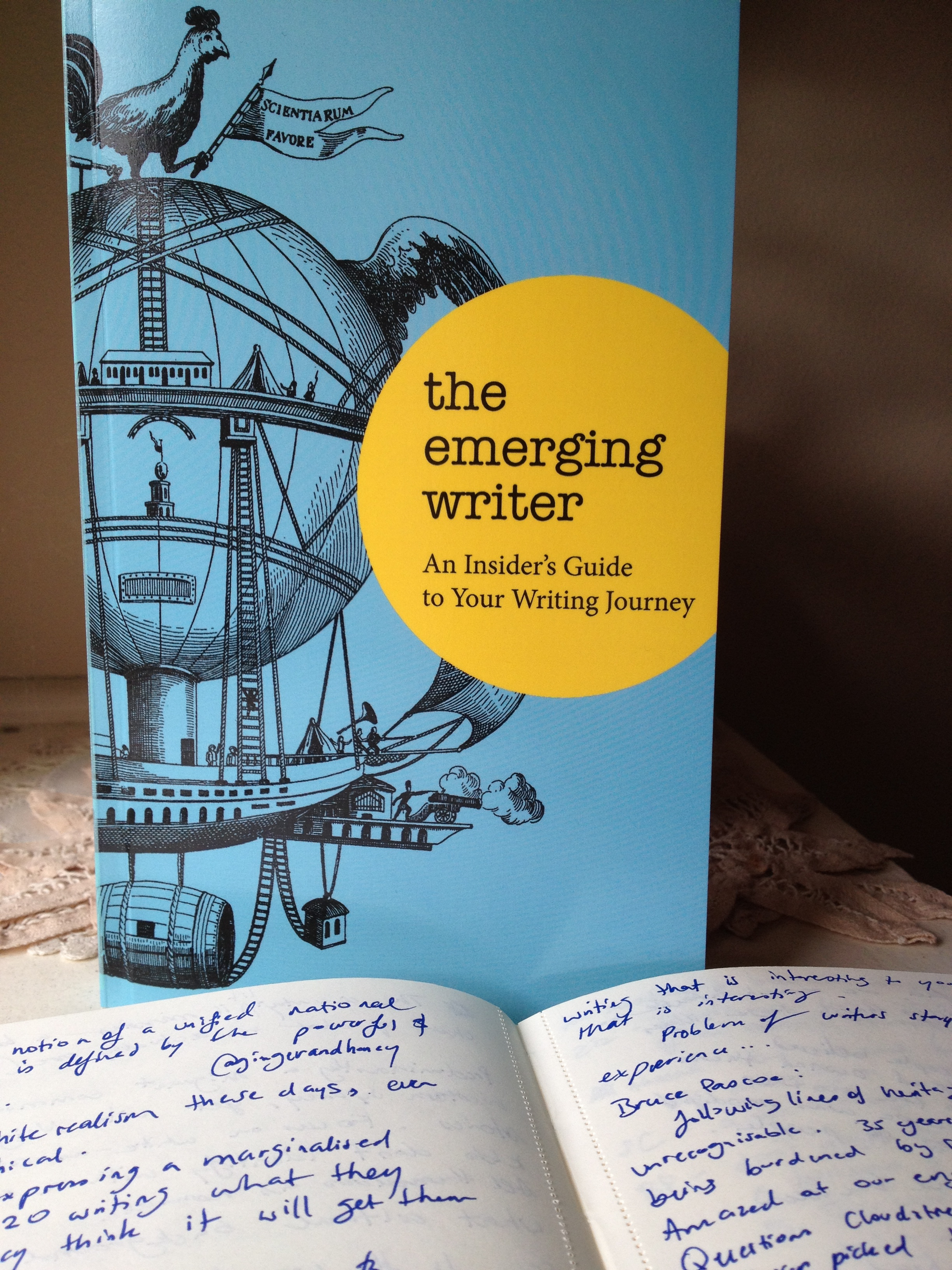
The Emerging Writers’ Festival finished on Sunday, but the ideas and inspiration that it created will hopefully linger for some time to come. From the pages and pages of notes (and quite a few tweets) that I wrote during the festival, here are those points that struck me the most:
 Dan Giovannoni on loneliness: “I’m not sure if I like loneliness because I’m a writer or if I’m a writer because I like loneliness.” This topic of writers as working essentially alone came up quite a bit at the festival, with some arguing that writing is a solitary pursuit, while others pointed out that writing (hopefully) involves relationships, too – with editors, publishers, other writers, readers, audiences and writing groups.
I don’t disagree that writing involves relationships – if you want to have an audience, that is – but I think that misses the point. For most writers, there is a phase of aloneness (not necessarily loneliness), that is both driven by a need to write, and is ultimately a driver of the writing process.
Emerging Writers’ Festival: Aussie Voices
On Sunday I attended the Aussie Voices panel as part of the Emerging Writers’ Festival Town Hall Conference. The panel proposed the questions, “Does Australia have a literary voice? Who tells the stories of Australia? And are our literary voices representative of the people of Australia?”
I’ve been thinking about it ever since, because some of the questions it raised relate to things that I am grappling with in my own work.
Tamara Barrett has blogged about the session, and she has some good quotes from the panellists that I missed. What I want to engage with here is the question of how white writers – writers of Anglo descent – can contribute to a diverse voice in Australian literature. It’s something that Barrett raised in her blog post, and that crossed my mind during the panel as well.
Australian Literature: what should I read next?
For the last few months, Thursdays have been a good day. Most Thursdays, I’ve jumped on a tram in the afternoon and headed into the city for the Wheeler Centre’s Australian Literature 101 series.
But now the series is over. I’m going to miss it, as every session has without exception provided food for thought or inspiration for my creative writing. Better still, it’s prompted me to read books that I might otherwise have neglected.
The question is, what should I read next?
Admittedly, I still need to catch up on the reading that I begun as a result of the series. I’ve yet to finish Patrick White’s Voss, dense tome that it is, as I was distracted by Monkey Grip and That Deadman Dance.
That Deadman Dance was the subject of the final session. I’ll write a post specifically about it soon, but in the meantime I want to start a list of Australian literature to read once I’ve finished Voss. (And once I’ve handed in the 10,000 words of essays that I have due over the next month!)
Michael Heyward of Text Publishing has an article in The Age today about the lack of interest in Australian literature, specifically at universities. It’s a topic that Heyward has been writing about a lot lately, alongside of the release of the Text Classics series.
It’s great to see this debate getting so much air, and I know that my reading experience has been enriched over the last few months thanks to the spotlight that’s been turned onto Australian literature.
The Wheeler Centre is going to run a second series next year, Australian Literature 102, and they have invited us all to contribute to the discussion about what that series should look like. Should it be thematic? Or chronological? Should the books be famous, or relatively obscure?
Readers, what do you think? In Australian literature, what books or plays or collections of poetry would you like to talk more about, or learn more about?
AusLit101: on Voss and Monkey Grip
Two Thursdays in a row I’ve climbed the short steep steps outside the Wheeler Centre, each time with a half-read novel in my bag. First Voss, then Monkey Grip: two very different books.
And, in the space of one hour on each of these evenings at the Wheeler Centre’s Australian Literature 101 series, two very different literary critics have shared their thoughts on these Australian classics and on what they mean to our literary landscape.
These two books, one that I’ve now nearly finished in the few hours since the session ended, are flooding my mind and my diary with very different thoughts and ideas, about writing and life.
Last Thursday the book presented at the Wheeler Centre was Voss, the author of which is Australia’s only winner of the Nobel Prize for Literature, Patrick White.
The presenter was Peter Craven, critic and cultural commentator, seeming ever so slightly bored to be there but more than happy to talk about Patrick White, about how White “imagined us into being”, and what this meant to Australia.
Tonight the book was Monkey Grip, originally published by McPhee Gribble because it was a bit radical. The author is Helen Garner, writing of and from within the Melbourne that she knew, in the ’70s.

Kerryn Goldsworthy was the presenter this time. She was given a copy of Monkey Grip for her twenty-fifth birthday, the year after it was published. She spoke about the book as one who loves it and for whom it resonated, most particularly at the time but, one senses, even now.
My copy of Voss, half read before I put it down to start Monkey Grip for this week’s talk, is smooth and nearly new and cost me $5 on a bargain table. It’s a Vintage Classic, print tight and thick on cream pages. It sat unread on my shelf for nearly two years and now is waiting on my bedside table until I get back from my journey to 1970s Melbourne.
Monkey Grip has my mother’s name inside the front cover, and the date, January 1979. It was published in 1977, so maybe it did not immediately seem so relevant across the continent, far away, where the sun sets into the ocean and the changes of the seasons are easily missed.
The book falls open in a precise spot, where a few pages are falling out. All through the text, against the small print on brown pages, there are pencil marks. I recognise what I think might have been my mother’s concerns, her interests, back then.
There are lines beside the paragraph on children delimiting the scope of women’s lives and freedom. Grey pencil runs under those phrases where something is captured, purely and cleanly in prose, something messy about love, or loneliness, or addiction.
Voss impressed me from the beginning; I saw the characters of Laura and Voss drawn so densely in the opening chapter. I read on through their meeting in the garden, their meeting of minds or souls; of recognising each other’s flaws. Peter Craven placed the novel in a hierarchy of worth. He said it was a parallel of Moby Dick. He was certain of Patrick White’s place in the canon of literature in English – not up to the mark of James Joyce, of course, but as “good as Beckett or Nabakov”.
Kerryn Goldsworthy spoke tonight of what makes a classic. Critics don’t decide what makes a classic, she said, but readers do. She spoke of the second wave feminism of Monkey Grip – how it was not just about the fight for equal pay but also about women working out how to live their sexual lives. Goldsworthy said that Monkey Grip, and Jessica Anderson’s Tirra Lirra by the River, both with main characters named Nora, marked the beginning of a period when more female writers were able to get their work published.
Monkey Grip makes me want to write more, and it makes me think I can, and should, write with more surety than I do, in this voice that I have, this voice that is mine.
Reading Voss, I admire it and appreciate it, but I struggle for the vision – struggle to ever imagine having the vision to be able to write like that. That’s to be expected, you might say, for it is Patrick White after all.
Reading Monkey Grip, I think instead, I don’t need that vision – I have my own, I just have to free up my mind and my words and let it come, with the clarity of my own voice, and thought, and imagination.
Social media: between friends and strangers
Lately I’ve been pondering the situation that all of us using social media or blogs have faced at some stage – or will inevitably face – that of having one’s ideas challenged. Sometimes the challengers are rude, sometimes not; sometimes they are friends or acquaintances, often not.
For me, the challengers on Twitter are almost always strangers. It’s rarely worrying – if the comments are thoughtful and reasonable, I think about it and respond accordingly. It is, after all, what must one expect if putting one’s ideas into a public forum.
If the comments are rude, I ignore it or make a joke of it. I wish that people would express their disagreements by arguing reasonably against the ideas instead of rudely attacking or dismissing, but otherwise it is no big deal, because these rude people are inevitably strangers.
But recently a post of mine on Facebook attracted a comment from a friend that still makes me angry, two weeks later, every time I think of it.
The post was about the suspension of the Queensland Premier’s Literary Awards. I wrote:
Important Queensland programs going down the tube already – less than two weeks since the election. Unbelievable. Axing the QLD Premier’s Literary Awards will save all of $250,000 out of a budget of billions. Watch the cultural exodus begin again.
A friend, who is also a family connection, responded in a manner that wasn’t rude (and compared to most online commentary, is positively innocent). But it was thoughtless and they didn’t offer an argument to support their viewpoint. The comment read:
What’s so important about an award for literary? 250K, no wonder why they scrapped it. I mean come on.
I wrote a few short lines back pointing out that I’m a writer so maybe that would give some clue as to why I think it’s important. My response was completely measured, and in hindsight I think that’s part of the reason I keep thinking about it: because I really wanted to get angry about it. I wanted to say exactly what I thought about the comment’s lack of respect for me as a writer and for the craft of writing.
I’ve let it lie. After all, the comment was not rude and I probably have no right to feel offended. But the fact that it bothered me so much has got me thinking.
As I increase my social media presence, the lines are blurring between friends and strangers, and between the media directed primarily at strangers – this blog and my Twitter account – and that which is open only to “friends”, or at least to people I know – Facebook.
Where once my political opinions mainly stayed on Twitter, they’re now straying onto Facebook. And so it seems I must face the disagreement of people I actually know – far harder than the angry comments of strangers.
Many of my friends are cut from very different political cloth to myself. Some of my friends question why I associate with others who hold an utterly different viewpoint and whose interests, beliefs and even fashion choices are anathema to them.
So there are bound to be disagreements. Mostly, my friends will argue their point with purpose and logic. They’ll have a reason behind their beliefs and to some extent will recognise what lies behind my contrasting beliefs. But sometimes they don’t, and this is when it gets tough.
If I don’t like it, I guess I could stick to bland status updates and photos of cute animals on my Facebook page.
Somehow, I don’t think that’s likely, and in the end I am happy to argue, debate and discuss. I just hate comments that shut others down or that have no valid reasons behind them.
But it’s vital to be exposed to different views in order to be an engaged citizen of a democracy, and if one of the ways that happens is through my social media friends or by strangers on Twitter, then so be it. But along the way I had better hope for patience, and know when to let things go.
Pedder Dreaming: Forty years since the flooding of Lake Pedder and the beginning of a movement
 Ten days ago, Senator Bob Brown delivered the 2012 Greens Oration, on the 40th anniversary of the founding of the United Tasmania Group, the first of many in a series of green political parties that have formed across the globe since that time.
This year also marks forty years since another key event in the green movement: the flooding of Lake Pedder, in the mountains of Tasmania.
The battle to stop construction of the Franklin River Dam during the late 1970s and early 1980s is perhaps the most well-known environmental battle in Australia’s history – and a successful battle at that. But this campaign had its roots in the fight to save Lake Pedder, a fight that was made famous in part through the photography of Olegas Truchanas.
Truchanas was a Lithuanian immigrant who, in the aftermath of his experiences in World War II and having left his homeland behind, developed a passion for the Tasmanian wilderness. Through his photography, he sought, in the words of Natasha Cica, to “bear witness to its remarkable beauty, to document, to protect”.
He was part of a group of Tasmanian artists, writers and photographers who journeyed to Lake Pedder to record and capture its unique and outstanding beauty, and who were strongly opposed to the Hydro Electric Commission’s plan to build three dams that would flood the lake, drowning its sandy beaches.
This group and in particular Truchanas himself are the subject of a 2011 book by Tasmanian writer and academic Natasha Cica, Pedder Dreaming: Olegas Truchanas and a lost Tasmanian wilderness. This beautiful book tells the story of Truchanas and of the period leading up to the flooding of the lake not only with words, but with visuals: Cica’s narration is intimately connected to photography and art.
The book is visually stunning, with matte pages lending a softness to the images reproduced throughout. This is fitting, given that Truchanas’s photos were known for their softness as a result of the single, “lousy” lens that he had for his Nikon 35mm camera.
The photography in Pedder Dreaming is essential to both the book and the story. Through the course of nearly 250 pages, Lake Pedder is captured in so many ways: soft in the morning light, still and monochrome under the moon, rich and colourful, reflecting the mountains and the trees.
Of course, Lake Pedder is no more: those who fought for the original lake’s preservation refuse to call the new body of water by the same name. The original lake had a maximum depth of around 3m with two islands; the new lake extends to 43m deep in parts, and has 45 islands. The new lake is not really a lake at all – it is a reservoir, an artificial impoundment.
Pedder Dreaming illuminates the scale of the tragedy of Lake Pedder, but it is done without drama or prosthelytising. Cica’s narration touches on the divided nature of Tasmania today and on the unique closeness of the island community, then and now. The story is told largely through the eyes of those who were there at the time, including Melva Truchanas, artists Max Angus and Trish Giles, and educator Elspeth Vaughan.
It reveals their sense of what was about to be lost and of the emerging environmental ethic in Tasmania, an ethic that took so much of its inspiration from Olegas Truchanas. Truchanas was the first to navigate the full length of the Serpentine and Gordon rivers in a kayak in 1958, photographing his journey along the way. He used his photography to show Tasmania’s wilderness beauty to a wider audience, fighting to save Lake Pedder “by mesmerising people with its beauty”.
Olegas Truchanas’s voice ends with the flooding of the lake in 1972, for he drowned the same year while attempting to repeat his journey down the Gordon River. He had lost all of his negatives and slides from his first trip down the Gordon during the 1967 Tasmanian fires. The battle for Lake Pedder was lost, but he knew that the Gordon faced a similar threat and felt that a future campaign to save it would require its beauty to be captured on film.
Then, as now, development projects are usually spoken or written of in terms of a particular anthropocentric benefit, most often in terms of economics and opportunity. Pedder Dreaming is the story of people who questioned this framework and questioned the right of humans to destroy a place like Lake Pedder.
The title Pedder Dreaming means many things throughout Cica’s book and resonates in a number of ways. For me, the story of Lake Pedder adds strength to a particular dream that I have: that we may one day accord to the natural environment the respect that it deserves, for its own sake and not for our own.
 equineocean