Film review: Midnight in Paris

Woody Allen has long been known for his love of New York, and for films such as Manhattan that pay homage to the famous American city. Recently his attention seems to have shifted to Europe, through writing and directing Vicky Cristina Barcelona (2008) and now Midnight in Paris. Both these films are expressions of love – albeit romanticised – towards the respective cities of their titles.

Midnight in Paris is not as strong as Vicky Christina Barcelona, but it is equally fun and delves into a similar theme: the enchantment of Europe for some Americans – in particular, the dreamy, wannabe-Bohemian, with aspirations towards artistic endeavour.

In Vicky Cristina Barcelona, the dreamer was Cristina (played by Scarlett Johansson), whose artistic endeavour was photography and who revelled in the sexual freedom that she found in Barcelona. In Midnight in Paris, the dreamer is Gil (Owen Wilson), a scriptwriter who has hit the big time with formulaic Hollywood movies but who longs to be a novelist.

Gil is on holiday in Paris with his fiancé Inez (Rachel McAdams) and her parents. The parents are boring and conservative, and Inez, although beautiful and eager to enjoy herself, looks set to follow in their materialistic footsteps.

Inez likes the idea of Gil’s dreaminess, but in Paris the bohemian streak soon becomes too much for her. She begins to prefer the company of some friends she bumps into while in Paris: Carol (Nina Arianda) and Carol’s pedantic, arrogant partner, Paul (Michael Sheen).

The movie begins with a series of scenes of Paris, setting up Gil’s seduction by the fantasy of the city. He and Inez do the touristy thing, visiting museums and gardens. Carla Bruni appears as a museum guide, arguing with Paul over Rodin’s mistresses and later translating some French for Gil; there is a certain irony in the first lady of France showing tourists around a garden.

Gil’s love for Paris is tainted, however, with nostalgia. Paris as it is cannot quite satisfy him, and he longs instead for Paris of the 1920s. Inez thinks he’s barmy, and while she is out dancing with Paul, Gil walks the streets at night. His fantasy becomes a reality when he is in the right place at the right time, and accidentally hitches a lift into the 1920s.

There, Gil meets the famous writers and artists who lived in Paris at the time: F. Scott and Zelda Fitzgerald, Pablo Picasso, Ernest Hemingway, Gertrude Stein and others. At this stage I was happy to be lulled into Gil’s fantasy: what a dream, to meet Hemingway and Stein! One almost wants it to be true.

Wilson has the perfect face for this role: his wide-eyed stare as he starts to realise where he is after meeting the Fitzgeralds might seem forced on any other actor, but he pulls it off by looking like a good-natured, surprised puppy who is rather desperate for attention.

The movie also stars the Oscar-winning Marion Cotillard as Picasso’s short-term girlfriend Adriana. Gil falls for her, seduced as much by her embodiment of the era as by her as a person. She, however, thinks the ’20s are quite boring, and longs to live during the Belle Époque. She unintentionally makes Gil realise that he is not alone in his nostalgia: at each stage in history there will be those who look back longingly at what came before, and who are too distracted to appreciate the beauty of the age in which they live.

Gil’s nostalgia struck a chord for me, as I have always dreamed of a world before cars and diesel power, when sailing ships ruled the seas and people rode about on horseback. Allen seems to suffer from nostalgia too, telling New York in 1998 that he regretted being too young to have experienced New York during the ’20s and ’30s.

As in Vicky Cristina Barcelona, the main characters of Midnight in Paris are upper-middle class Americans in a European city. On the one hand, Allen critiques these characters, particularly Inez and her family who see Europe as a holiday destination through the lens of their own superiority complex. On the other hand the film only confirms this attitude by not probing beyond the surface layer of the city. In Vicky Cristina Barcelona and Midnight in Paris, the cities are seen as they would be by tourists: enchanting, full of sexy people of the opposite gender, and a long way from the constraints of the US. Midnight in Paris represents the view of an outsider who approaches with a preconceived notion of Paris; a notion that experience does not seem to alter.

Midnight in Paris is light and fluffy, and while Gil’s relationship with Inez is quite implausible, it is easy to be swept up in his fantasy of Paris. It is a city that has long seduced artists through promises of freedom and inspiration, and Allen’s latest film does nothing to detract from this ideal.

A day on earth in Daylesford

Yesterday I went to an auction – thankfully not a house auction nor a clearance sale, but instead the auction of artist David Bromley’s collection of art and objects. He is leaving Victoria and as a result his enormous collection is being sold – yesterday was part I of the auction, at Shed 4 in Daylesford…


I was blown away – the huge warehouse was full of things. There was some of Bromley’s own artwork, such as the painting against the wall in the photo above (“Cheyenne”), as well as some of his sculptures. There were old vehicles, including the mini panel van and trailer above, covered in Bromley’s own print.

It’s the first auction I’ve been to as an adult, and it was interesting to see some pieces sell for below the expected price range shown in the catalogue, while others, like the shelf on the right of the photo above (described in the catalogue as “A rustic pigeon hold unit of twenty compartments”), sold for far more.

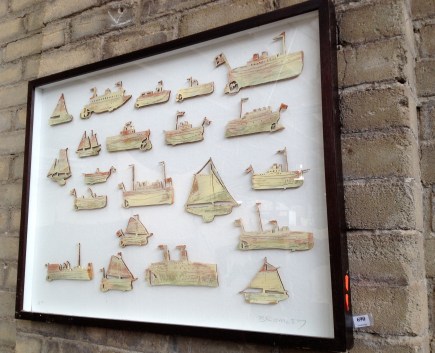
I loved this – “Group of boats”, oil on timber cut out, and watched it sell for over the estimated price, which nonetheless seemed reasonable. For the first time I had a hint of the pleasure one might get out of starting an art collection, of going from place to place seeking those artworks that strike a chord…

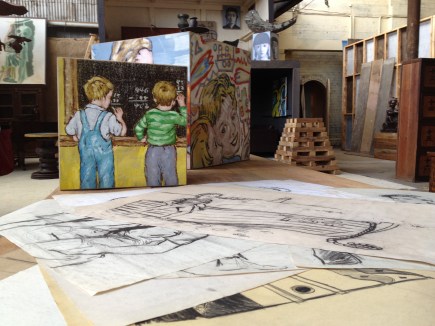
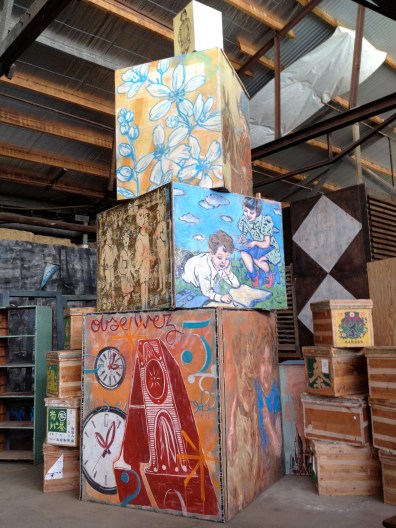
The above image shows a collection of Bromley’s sketches, laid out on a table with a lot number, ready to be sold together. Behind these are some of the many Bromley-painted cubes in the warehouse, with a different scene on each face.

The beauty of the warehouse, with the combination of furniture, art and random objects (like the ventilator funnel off a ship, or an old tin bath), lay for me in the anticipation of creativity. There was a quote from Bromley in the catalogue:

Over the years collecting for me has been no different to buying oil paints or art materials – they are all the raw materials for “painting and sculpting” the framework of my life – pieces I collected, curated, selected, sorted and then placed in my world to create a living environment that I cherish and live amongst.

I wonder how it feels to leave it all behind. Perhaps it feels like freedom, or perhaps like loss. Or perhaps it is simply time to move on, to create a new environment for the artist’s creativity, or a new Day on Earth.

I surprised myself by finding something amongst Bromley’s collection of furniture that I both wanted, needed and could perhaps afford. So I registered to bid and participated in a little bidding war with another buyer, my heart thumping away in excitement. I reached my limit and stopped bidding, stepping back from the gamble that an auction inevitably is.

I’ve come home empty handed in terms of material objects, but in spite of this I’m glad that I saw it: an incredible, eclectic and inspiring collection housed in a huge warehouse. I’m glad too that I watched as it was broken up, its myriad pieces distributed amongst those who came to see it and, if they were lucky, who took something home.

Photo credits: Panel van/Cheyenne, Baby grand/tin bath and Sketches/cubes: No Fixed Address. The remainder: mine.

Four polaroids of the sea

Four images of the ocean and its edges, in various guises and moods. Peaceful, the tide out, so that light and figures reflect off smooth wet sand. Hidden on impossible film, so it is less the ocean you see and more the curve of the hillside beyond; you can only see the sea if you know where it is. Down by the breakwater, the waves will always break against the rocks, brought up short by them unexpectedly. And out to sea, a rainbow spears from the cloud and into the ocean, mirroring the multiplicities of colour that break and refract through the spray of the waves as they roll, curling, curving, crashing, a flurry of whitewater and sunlight, in towards the shore.

The media ‘sideshow’ and its influence on debate

Earlier this year, Lindsay Tanner, ex-Labor MP for the seat of Melbourne, released Sideshow: Dumbing down democracy. After seventeen years in parliament, Tanner had reached the conclusion that the relationship between politics and the media was becoming increasingly destructive, and that consequences were emerging for the health of Australian democracy.

In America in the 1920s as modern journalism began to take shape, there was a lively debate about the role of journalism in a democracy. What became widely recognised from this time on was that the media has an obligation to serve the public interest, and that profit motives should not be the sole force in determining media behaviour.

As an aspiring journalist, the relevance of this idea in today’s media world is of prime concern to me. Am I entering an industry that is purely market-driven and in which I must obey market forces in order to survive, or do I have responsibilities to the public that outweigh commercial motives?

Tanner states early in Sideshow that ‘the media are an absolutely critical component of our democracy, because genuine democracy requires an informed electorate’ (page 6). Tanner goes on to argue that democracy is being threatened by the destructive relationships between politics and the media. He sees this as being largely due to the increasing orientation of the media towards entertainment and commercial pressures, which leads in turn to a dumbing-down of public debate.

Tanner’s book does not lay sole blame for this process on the media. He argues that most politicians end up buying into the game for the sake of their own political survival. Political survival depends on media coverage, and coverage depends, at least in part, on politicians playing the media game. Tanner himself seemed to keep largely clear of the media ‘sideshow’; by his own argument it is perhaps inevitable that he was not one of the most popularly well-known politicians.

While I feel that politicians do have a case to answer in terms of their own behaviour, many of the reviews of Tanner’s book, such as David Penberthy’s in The Australian, focus heavily on the responsibility of politicians and divert attention away from the role of the media. For an emerging journalist like myself, however, that approach is unhelpful. The relationship between the public and politicians is largely mediated through the media, and thus it is up to me to know and to understand the ways in which my own future behaviour as a journalist may or may not impact upon the nature of political debate.

Many of Tanner’s points are not new, but what Sideshow does so well is to extensively examine how many features of political media coverage actually have an affect on the behaviour and decisions of politicians.

One of these features is the short attention span of media, particularly broadcast media. This manifests in ‘gotcha’ journalism and in the focus on sound grabs. ‘Gotcha’ journalism refers to journalists picking up on a small slip of the tongue or careless inference made by a politician, and turning it into a news story, usually with negative implications. As a result, argues Tanner, politicians end up scripting everything they say in order not to get caught out.

This ties in with the notion of ‘sound grabs’ – it’s a good idea to have something quick and catchy to say to the cameras, to ensure that it gets coverage in the limited space available on TV news. The problem is that sound grabs lead to the rise in slogans – we’re all familiar with ‘moving forward’, ‘stop the boats’, ‘another big tax’. Slogans like this say little about anything – they’re phrases thrown around that leave no room for complex messages and that become meaningless, yet are reported because they are easy to capture in a few seconds of TV coverage.

As Overland editor Jeff Sparrow wrote on The Drum earlier this year:

… a soundbite culture inevitably favours the repetition of accepted wisdom. When politics becomes a matter of fleeting images, quick clips or brief audio grabs, there’s no room for complexity and nuance. Rather than challenging you or forcing you to think, soundbites tell you what you already know.

This doesn’t mean that complex issues aren’t being discussed and worked through behind closed doors. The thing is, it’s hard to know – the short attention span of the broadcast media means that issues often fall out of the spotlight very quickly, and so it’s hard for the public to tell if something is actually being done about the matter or not. According to Tanner, one of the key rules governing the ‘practise of Australian politics’ is to look like you’re doing something. And so we end up with short-term fixes and ‘announceables’ – tidbits announced by politicians to keep the media and public happy.

Far more destructive than these examples is the media’s tendency towards negativity and to playing on the fears of the audience, both of which Tanner identifies. According to the Centre for Policy Development, fear ‘has become a central feature of both media reporting and contemporary politics in Australia’. Nowhere is the impact of these tendencies so visible as in the debate over asylum seekers in Australia – specifically, asylum seekers who arrive by boat.

The issue of irregular maritime arrivals, commonly described as ‘boat people’, has been heavily politicised in Australia, particularly since the incident of the Tampa in 2001. It is a juicy issue for the media – full of potential as a politically divisive and partisan issue, and an emotive issue with the potential to instil fear in the audience.

The coverage of ‘boat people’ in the media and the response of politicians is out of proportion with reality. Tanner points to an April 2010 headline in the Herald Sun, ‘Someone has to stop this invasion’, as an example of media exaggeration. He states on page 52:

Media distortion of perceived threats can sometimes have far more sinister effects than simply wasting public money … Here, as elsewhere, the flavour of media reporting heavily influences perceptions of basic facts, such as the number or nature of boat people.

Mainstream news outlets rarely remind their audiences that Australia’s total refugee intake in 2010 was 13,750 people – just 0.06% of Australia’s population – a figure that should serve to put debate over ‘boat people’ into context.

But is it really the media’s fault if asylum seekers are a hot button issue? Or if news bulletins are awash with three word slogans and footage of politicians in hard hats?

The former head of news for the Associated Press’s World Services, George Krimsky, has this to say about the role of the press in a free-market economy:

There is nothing in the American constitution that says the press must be responsible and accountable… in a free-market democracy, the people ultimately decide as to how their press should act.

Krimsky blows the idea of media responsibility out of the water with this quote, suggesting that the burden of responsibility is on the people – through the free market – to consume media that IS accurate and accountable. In other words, if we, the consumers of Australian media, want depth of coverage, then we need to choose the media that offers this.

It turns into a chicken-and-egg scenario: is the media sensationalist and driven by entertainment value because that’s what people want, or are people forced to consume it because there is nothing else available to them?

In spite of Krimsky’s harsh words about the role of the press in a free-market democracy, he concludes the same article by saying that if truth doesn’t remain a motivating force for the mass media, then ‘neither free journalism nor true democracy has much hope’.

From my point of view, there’s a responsibility at each level to ensure that politics isn’t dumbed-down and to ensure that the media is responsible and accurate. Politicians have a role to play in this, as they have a responsibility to communicate with their constituents in a manner that allows for rigorous debate on the issues. The public similarly have a responsibility to ask for, and take part in, this debate. And the media has a role to play in helping to create an environment in which this debate can take place.

Journalists are both consumers and producers of media, and therein lies a doubly weighty responsibility in upholding the quality of public debate.

Letter to The Australian

I would like to point out a problem with Brendan O’Neill’s argument (“Silence of the Illiberal Lambs”, 5/10). He refers to students who burned copies of a newspaper containing a sexist cartoon as “highly intolerant individuals”. But what about the cartoon that these students protest against? If it was indeed a sexist cartoon, then it is guilty of intolerance towards women.

Similarly, Andrew Bolt’s unwillingness to consider views that differ from his own indicates that he, too, is an “intolerant individual”.

Given that patriarchial Western society denied women and displaced Indigenous people any voice on the public stage for hundreds of years, it seems ironic that O’Neill should denounce these groups for merely seeking fair, correct representation in today’s media.

Published in The Australian on 7 October 2011. It’s the second letter on this page.

Navigating the disconnect between Manne and The Australian

Between academic Robert Manne and our esteemed national broadsheet The Australian, a battle is – or was – underway. It began three weeks ago when an extract from Manne’s Quarterly Essay appeared in The Age, followed by the publication’s release shortly afterwards. Bad News: Murdoch’s Australian and the Shaping of the Nation argues that The Australian is no longer a paper that reports accurately and comments on current events, but that has ‘turned itself into a player in national politics’.

The Australian brought out the big guns in response, with 8000 words of criticism on Manne’s essay – and on the man himself – in just one issue of the paper. The Australian has since decided that there endeth the debate, as upstart’s Matt Smith noted following the absence of the paper’s representative at the Wheeler Centre debate last week. Perhaps The Australian has realised their folly in giving so much attention to Manne’s ‘silly essay’, as editor-in-chief Chris Mitchell described it.

With the word length of a novella at his disposal in Bad News, Manne takes a different approach to the issue than many commentators who are restricted to shorter forms of commentary. He methodically investigates several of The Australian’s coverage areas in order to support an argument of media bias that to some seems quite obvious, but that to The Australian is an accusation quite without merit. It is refreshing to see the various coverage issues dissected carefully and supported with relevant examples, instead of being skimmed over as shorter pieces often necessitate.

While the slanging match died down sooner than I expected, each side has scored their major punches and given an air of ‘my word against yours’ to the battle. Few readers have the time to trawl back through years of broadsheets, as Manne has done, to see whose argument is supported by evidence in the form of The Australian’s coverage of particular issues. But what one can do is read both sides of the argument with a healthy critical eye.

Of course, as readers and critics we bring our own perspective to the debate, one that can cloud the manner of criticism we offer. Let me outline the angle from which I approach this particular issue.

I grew up in Perth, where the local daily is the The West Australian, a tabloid format paper owned by Seven West Media and usually considered to have conservative leanings. Unlike many of my peers who were raised in Melbourne, The Australian was essential to my media diet throughout my late teens and adult life. While many Melbournites dismiss it and turn immediately to The Age, years of habit and a desire for a national focus mean that as a reader, my broadsheet loyalties still lie with The Australian.

My upbringing in what some easterners might see as the backwater of Perth has not stopped me from being able to engage critically with what I read. The Australian’s manner of depicting certain issues has rankled with me for some time.

This feeling came to a head during the 17-day period following the 2010 federal election, when The Australian consistently depicted the figures of the hung parliament in a way that favoured the Coalition. The most obviously misleading example of this was the inclusion in Coalition figures of Western Australian National Party MP Tony Crook, in spite of his explicit statement that the Coalition could not necessarily count on his support. Meanwhile, the seat held by Greens MP Adam Bandt was listed separately, in spite of Bandt having already indicated his support for a Labor government. With control of the parliament hinging on a few independents who were expected to make up their minds in a high pressure environment, this none-too-subtle shaping of the facts and prodding of public opinion was dishonest.

While Manne’s Quarterly Essay pursues issues that have been troubling me for some time, this does not mean that I embrace his arguments uncritically. In the section of the Quarterly Essay that considers the paper’s coverage of climate change, I was able to consider Manne’s argument in the light of my own experience as a reader. It is a topic that I have followed closely over the last few years.

On the other hand, I felt that Manne’s argument about Larissa Behrendt over an injudicious tweet was not developed convincingly, and that a great deal of his writing could have been clearer. I was also aware that I was not in a position to judge those criticisms of The Australian that relate to earlier this century, due to the fact that I was younger and less politically engaged at the time. For example, I take Manne’s argument over the Iraq war with a grain of salt, as I am aware that my own knowledge of the issue is insufficient to allow me to be appropriately critical. This exercise in critical thinking is essential to navigating the conflicting arguments of Manne and The Australian.

This brings me to the discourse of left-wing versus right-wing that is so dominant in political commentary. The constant labelling of public figures as one or the other implies a lack of critical thinking and unquestioning loyalty to a particular, limiting, ideological perspective. A large part of The Australian’s criticism of Manne is that he has swung from the right to the left, as though his loyalties miraculously shifted from one ‘side’ to the other. Manne’s apparent swing can be construed quite differently if this absurdly limiting spectrum is taken out of the picture: rather, his views can be seen to have evolved with time and experience, accompanied by a rare willingness to own and acknowledge this shift.

The Australian openly adopts a particular ideological point of view when it comes to political, social and economic issues. The problem is that the paper’s columnists often seem to neglect critical thinking – that essential tool which allows one to change one’s opinion as an issue evolves – preferring instead to delightedly adopt any piece of evidence that dovetails nicely with their predetermined ideas about how the world should work.

The reaction from The Australian’s commentators to Bad News is polarising, implying that one is either with Manne and against The Australian, or vice versa. The paper’s editor, Chris Mitchell, attributes ‘Green values’ to Manne, and since The Australian has in the past openly argued in support of the destruction of the Greens at the ballot box, one assumes that Manne’s ideas must be similarly destroyed.

This attitude is utterly unhelpful. The world does not split neatly into, on the one hand, Greens, leftists, latte-sipping inner city elites and humanities academics, and on the other, rational, hard-working, ‘real-world’ Australians. There is a complex range of views in our society, a range which the paper says it gives voice to in its op-ed pages even as its own rhetoric of left versus right continually denies this complexity.

On some issues, The Australian is capable of representing a variety of views. On others, such as on its own role in Australian political debate, the paper seems quite unwilling to engage critically or productively. Both Paul Kelly and Chris Mitchell have labelled Manne’s criticism as attack. This is another rhetorical bad habit, found on both ‘sides’ of the issue. There is a vast difference between critique and attack, and to blur the boundaries between the two does a disservice to public debate.

But of course, businesses and politicians are both adverse to considering their faults publicly. It seems ironic that we ask primary school students to self-evaluate, yet The Australian is unable to publicly do the same.

As I have said, I am a loyal reader of the paper. But in spite of this I do not trust much of what I read in its pages, both news and opinion, aware that there are often holes in the paper’s coverage or commentary. This makes me uncomfortable. Yes, debate is and should be uncomfortable, but not because our only national, general-interest broadsheet appears to be pushing its own point of view, with a frequent disregard for journalistic principles.

A shorter version of this piece also appears on upstart, and is available here.

Feminist success in The Age… or not.

I just about choked on my dinner last night when I finally got around to reading The Sunday Age and saw a picture of a couple waiting outside Mamasita in Collins Street – the woman on the left, the man on the right. And underneath, the following caption:

Nic Stewart and his wife, Alanna, join the queue waiting for a table at Mamasita restaurant, which has a no-bookings policy.

Is it just me that sees something wrong with that caption? Neither Alanna nor Nic are quoted in the article, so neither deserves preference in naming in the photo. Alanna is on the left, so therefore I would expect convention to dictate that she would be mentioned first. But no, Nic is mentioned first, followed by Alanna, who is not even described by her full name but rather described in relation to him. I don’t know whether or not she would be bothered by this, but if it was me, I would be incredibly offended. I’m offended anyway, not necessarily on her behalf but because I fail to see why the man in this photo deserves naming preference over the woman.

I know that both ‘Miss’ and ‘Mrs’ are still in use with no such distinction required for men, but the widespread use of ‘Ms’ gave me the impression that Australian society had largely moved beyond identifying women in relation to the men around them. I try not to pay too much attention to numerous newspaper articles that mention a couple and quote only the male partner, hoping that there is some reason behind the journalist’s choice. But in this case, the complete lack of justification for naming the couple in the order shown proves that we are not as progressive as I had hoped.

Perhaps the caption is a mistake and nothing was meant by it, or perhaps this happens all the time and I haven’t noticed. Either way, it’s innappropriate, and the meaning is there whether the subeditor intended it or not. If language really is power, then we women have an awfully long way to go.

Media fragmentation: a threat to democracy?

For many people who grow up in Australia, democracy is taken for granted. Turning 18 is a milestone for most teenagers not because of the right to vote, but because of the right to drink.

The first time I went to the polling booth at the age of 19, the decisions I made there were influenced by a variety of factors, not least my family and my studies. At that point, the role of the media in politics and in the decisions that I made as a member of the voting public was not something that I had thought about at any nuanced level.

Now, however, as an aspiring journalist and a student of Global Communications, the relationship between the media and politics is one that I find increasingly fascinating and important. Earlier this month I attended a public lecture held at RMIT as part of the Media, Communication and Democracy: Global and National Environments conference. The keynote speaker was Professor Paulo Mancini, from the University of Perugia, and a key focus of his research is the relationship between the media and democracy.

His argument was that while media fragmentation is not new, it is having more and more dramatic consequences that extend beyond the media, into politics and democracy. He associates the fragmentation of media with a ‘crisis in journalism’. Neither the notion of a crisis in journalism or media fragmentation are new ideas, but Mancini’s lecture clearly outlined the consequences of fragmentation, as he sees it, for democratic politics.

A key effect of fragmentation lies in the shift from mass audiences to niche audiences. No longer do people watch the same news at the same time on the prime television station of the nation; no longer is TV a ‘central space’, as sociologist Elihu Katz argued in 1996.

Australia may be unusual in having only one national general interest broadsheet. In theory perhaps The Australian could function as a ‘central space’, but the paper’s strident ideological views and relatively minor weekday sales of around 130,000 negate this idea.

While 70% of Australia’s print media is owned by News Limited, suggesting a possible argument against the idea of media fragmentation, newspapers are now just one ‘fragment’ of the media environment. The fragmentation of which Mancini speaks is a fragmentation of media systems and forms – so that journalism is spread across a variety of mediums, from newspapers and TV to blogs and YouTube.

According to the MEAA’s 2010 Life in the Clickstream report, 26% of people said that the internet was their main source of news. With online journalism offering opportunities for niche markets like never before, fragmentation of the media audience is also occurring. The audience is fragmented because the forms are.

As Mancini outlined in his lecture, niche audiences create a problem of polarisation whereby ‘people talk to other people already sharing the same opinion’. The idea of a universal public sphere comes to an end, and with it comes severe consequences for a functioning democracy that is able to negotiate between different perspectives and points of view.

This idea dovetails with aspects of Lindsay Tanner’s argument in Sideshow. Tanner argues that media outlets desperate to hang onto audiences (thanks to fragmentation and increased competition) tend not to challenge their audience’s views, but rather to reinforce them with increasingly strident rhetoric and sensationalism. Sideshow attracted the ire of a number of journalists and commentators who resent the blame that Tanner levels at the media, but he does argue persuasively that the relationship between the media and politics in Australia is increasingly destructive, with negative consequences for democracy.

Mancini indicated several times in his talk that it is emerging and fragile democracies that are most at risk of the effects of media fragmentation, including polarisation and a diminished ability of the media to play the role of watchdog over government. Yet even in Australia, in a strong and stable democracy, there is a persuasive argument for the case that our sphere of public debate is increasingly fraught.

O’Neill’s confusions

On Saturday, The Australian ran a comment piece by Brendan O’Neill in which he argues that ‘greens’ are anti-free speech by supposedly attempting to censor any hint of climate change scepticism. Some of the examples he uses include journalist Margo Kingston’s comment about climate change denialism being a crime against humanity. The comment was made in 2005 in the context of David Irving’s arrest for Holocaust denialism, and has already been used by plenty of commentators who think that ‘the green movement’ is trying to shut down free speech; including by O’Neill himself back in 2006.

O’Neill’s comment peice conveniently neglects to mention that while the occasional ‘green’ may have accused climate change sceptics of denialism akin to Holocaust denialism, one such sceptic has already gone several steps further in misappropriating the legacy of the Holocaust. I’m speaking, of course, of Lord Christopher Monkton. Perhaps O’Neill, as a recent arrival in Australian public debate, is not aware of Monkton’s comparison between Professor Ross Garnaut and Adolf Hitler. At a conference in Los Angeles in June this year, Monkton displayed a picture of a swastika beside a quote from Garnaut, and directly referred to Hitler (in relation to Garnaut) in his speech. Monkton’s act constituted misappropriation of Nazism on a much grander scale than anything that O’Neill has to complain about.

O’Neill is also guilty of a fallacy in his article. He assumes that because Al Gore and Margo Kingston are part of what he describes as ‘the green movement’, and that because they see climate change denial as an offence, that therefore the ‘green movement’ as a whole would like to censor the speech of climate skeptics. The ‘green movement’, or ‘greens’, in O’Neill’s usage, appears to be a generalisation applied to those who support the science of human-driven climate change, and therefore must include people from both sides of the political spectrum and from all walks of life who hold this view. The individuals that O’Neill mentions, however, do not speak on behalf of this diverse group of people, so quite apart from the tenuous nature of his argument, it is hardly accurate to attribute the views of non-representative individuals to an entire movement.

Frankly, the ‘green movement’ has bigger things to worry about than climate change deniers – namely, getting on with the business of mitigating the effects and slowing the process of climate change.

Kodak from the eighties

At the Box Hill camera market earlier this year we picked up a few random films, including a roll of Kodak Gold that expired in March 1989. Standard, run-of-the-mill film back then, but twenty years on it produces something quite different.

The risk of expired or cheap film is that sometimes there’s decent shots messed up by too much grain or strange colours. But then sometimes there’s a few that turn out alright…

This one was taken in South Fremantle in July, and I like the graininess in the colours of the sky:

And there’s this one, looking up the bay towards Melbourne from Brighton. I know, lots of ocean photos… They are hard to resist.

And then for something quite different, no water in sight, there’s this one shot by No Fixed Address on the same roll of film: